
Humankind 2 Sled Dogs Guide: Thule Customs & Polar Units
Adopt Thule Dogsled Hunters in Humankind 2 via Foreign Contact, unlock Polar Adaptations, and deploy sled-dog scouts without abandoning Egyptian culture.
Frequently Asked Questions
What does the Thule Dogsled Hunters Custom do in Humankind 2?
How do you unlock Dogsled Hunters without becoming the Thule culture?
Do Dogsled Hunters replace Polar Biome Adaptations?
Why did the October 2026 walkthrough use Ancient Egyptians in Greenland?
When should you activate Dogsled Hunters in Manage Customs?
What Is the Thule Dogsled Hunters Custom in Humankind 2?
Humankind 2 treats polar survival as a layered problem: where you live (Biome Adaptations), who you are (Cultural Progression Trees), and what you borrow from neighbors (Foreign Contact Customs). The Thule Dogsled Hunters Custom sits in that third lane. It is a Thule-specific tradition that unlocks sled-dog units tuned for snow hexes, fast reconnaissance across mountain passes, and early-era pressure on Arctic independents without forcing you to abandon your founding civilization.
During the official October 15, 2026 gameplay overview, Narrative Director Jeff Spock showed an Ancient Egyptian (Flood Tamer) empire sending settlers toward Greenland. Instead of instantly becoming the Thule at the Era Crossroads, the player kept Egyptian River Transport, Hieroglyphics, and Pharaoh’s Authority online while purchasing Dogsled Hunters from the Thule contact list. That single decision is the template for every “I need Arctic tools but I love my culture” campaign in Humankind 2.
If you have not yet mapped how Culture Points, Legacy Traits, and neighbor borrowing interact, start with the Culture Evolution and Customs guide—this page assumes you understand Manage Customs slots and Foreign Contact gates.
How Does Foreign Contact Unlock Thule Customs?
Foreign Contact is one of three historical links that also unlock cultures at the Era Crossroads (alongside Common History and Shared Land). For daily empire management, its most practical use is selective Custom adoption:
- Meet the Thule on Greenland or adjacent polar coasts through borders, trade, or expedition events.
- Open Manage Customs from your Egyptian (or any) capital UI and browse Available Customs contributed by neighbors.
- Spend Culture Points on Dogsled Hunters—cost scales with era and how many foreign nodes you already own (exact numbers may shift in Pre-Release 2027 builds).
- Assign an Active Customs slot before your army or settler train enters deep snow.
This mirrors real syncretism: Nile administrators did not stop being Egyptian because they learned Arctic logistics. Humankind 2 encodes that by separating culture identity from borrowed techniques. Your dynasty name, architecture palette, and Egyptian Legacy Trait path remain intact; you simply add Thule mobility to your toolkit.
Step-by-Step: Egyptian Expedition to Greenland (Video Walkthrough)
The frames below are verified against Amplitude’s First Gameplay Overview (O4ZTZafqFOw). Follow timestamps when you want to compare UI labels on your own pause screen.
- 01
Stage the Arctic expedition settlers
From your Egyptian core, produce a settler or expedition stack aimed at sub-Arctic land bridges toward Greenland. The walkthrough highlights coastal embarkation and a northern push—treat this as a dedicated logistics phase, not a casual scout loop. Stock food knowing polar biomes stress perishable supply lines until you unlock preservation nodes.
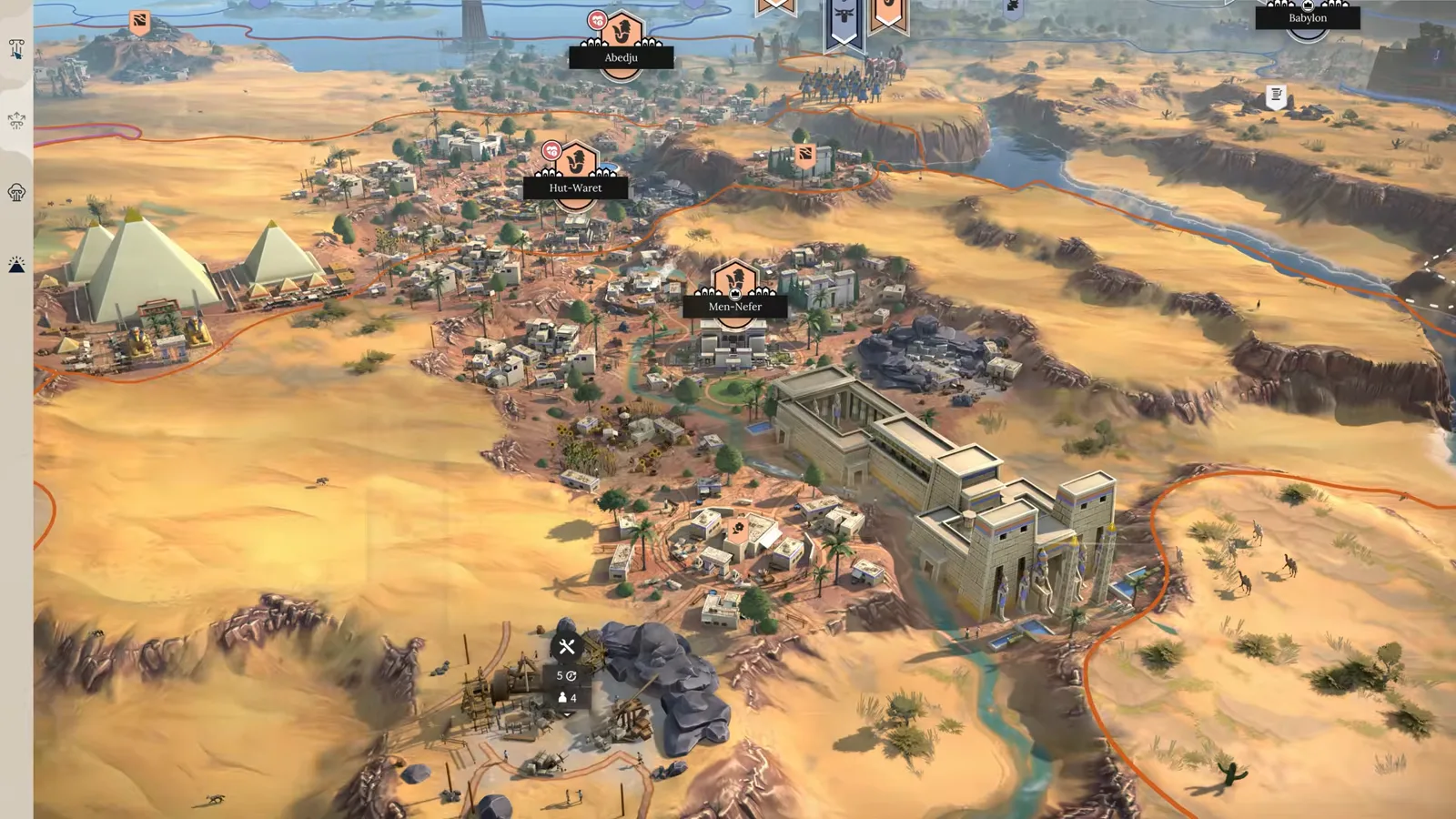
Expedition phase: commit settlers and supplies before you climb into polar mountains. Watch at 5:38 ↗ - 02
Claim the polar mountain outpost hex
Pin your first foothold on a snow-capable hex—often a mountain pass or coastal tundra tile that gates deeper Greenland territory. Outpost placement determines which Polar Adaptation nodes light up and how quickly Thule independents flip from neutral to contactable. Avoid splitting stacks across ice you have not adapted to yet.
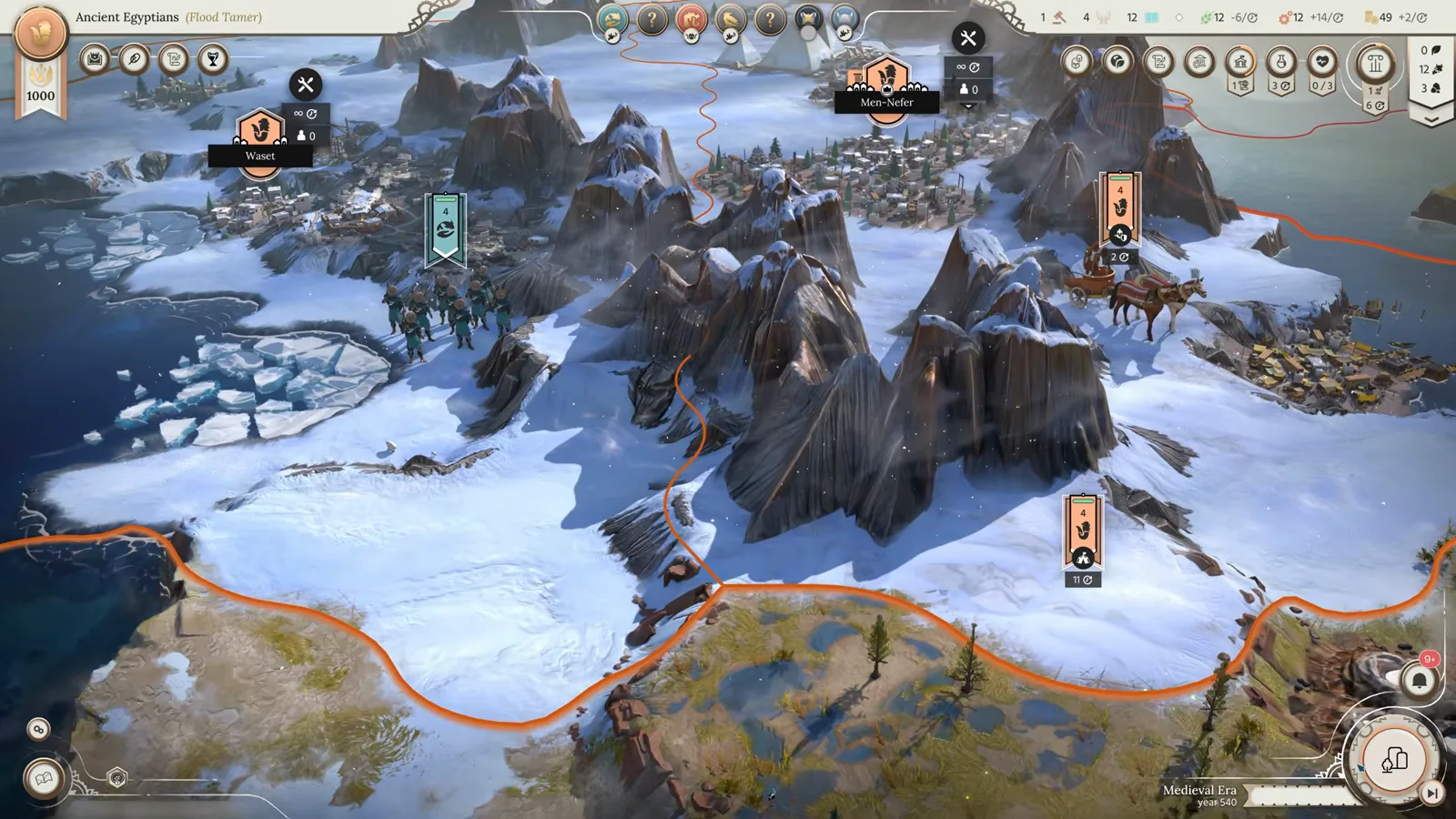
Foothold hex: one strong tile beats three overextended snow camps. Watch at 5:44 ↗ - 03
Progress the Polar Biome Adaptation Tree
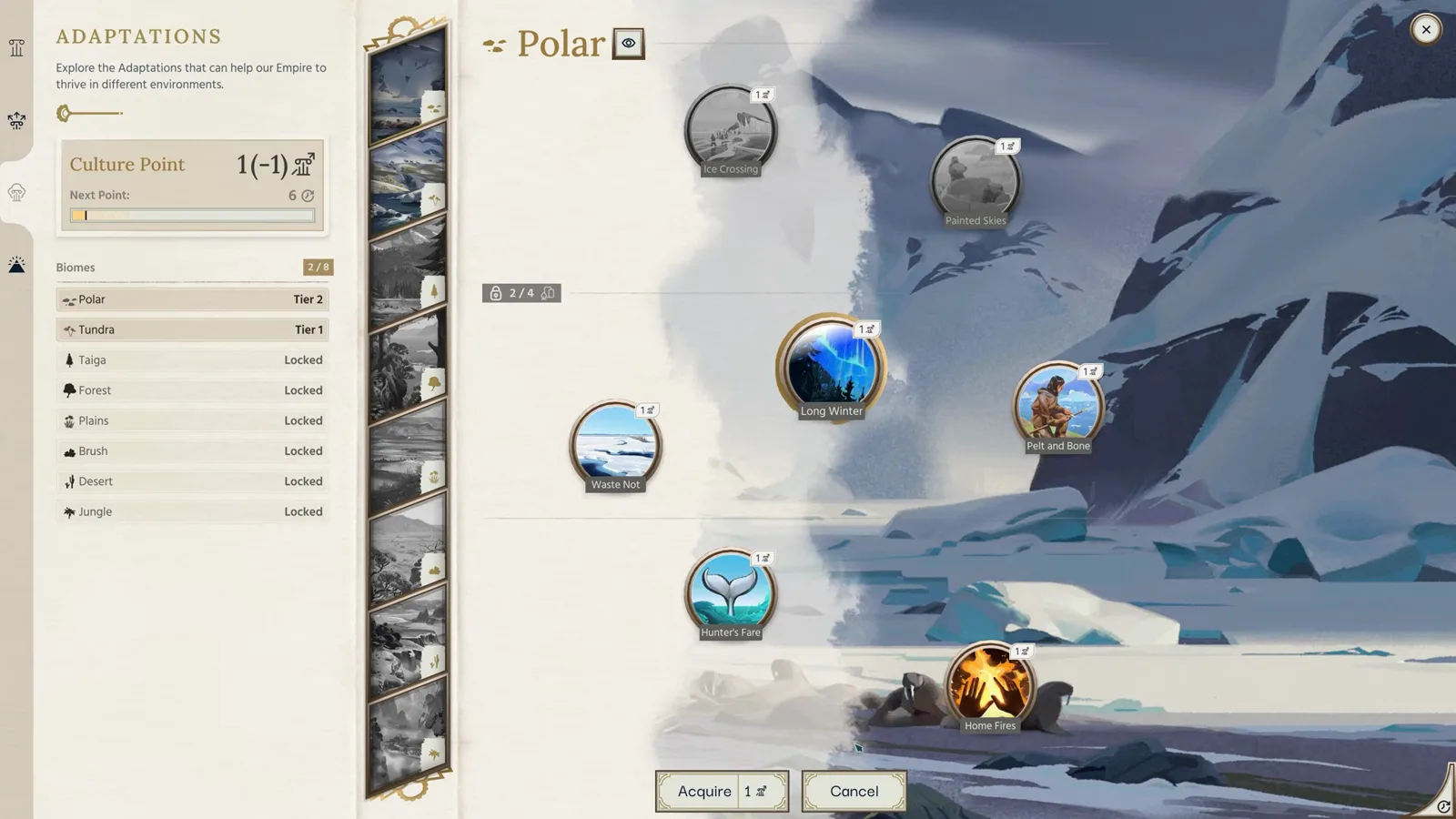
Open the Polar Adaptations panel tied to your new territory. Prioritize survival nodes—Ice Crossing for frozen routes, Long Winter for seasonal starvation relief, and whaling or seal hunting for coastal protein—before luxury yields. These nodes stack multiplicatively with Dogsled Hunters movement bonuses once you adopt the Thule Custom.
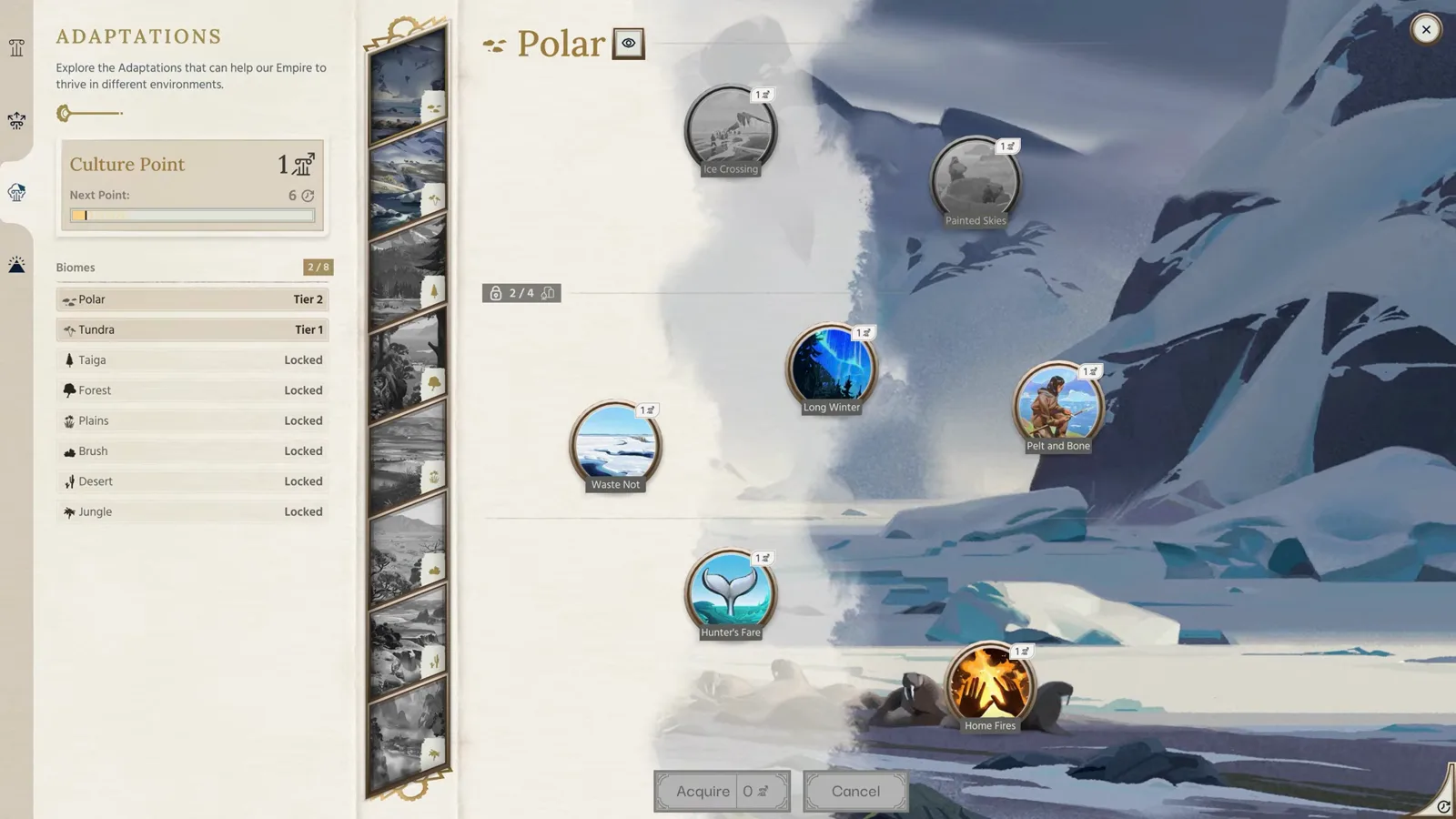
Biome tree first: adaptations reduce attrition before sled dogs arrive. Watch at 5:50 ↗ - 04
Adopt Dogsled Hunters in Manage Customs
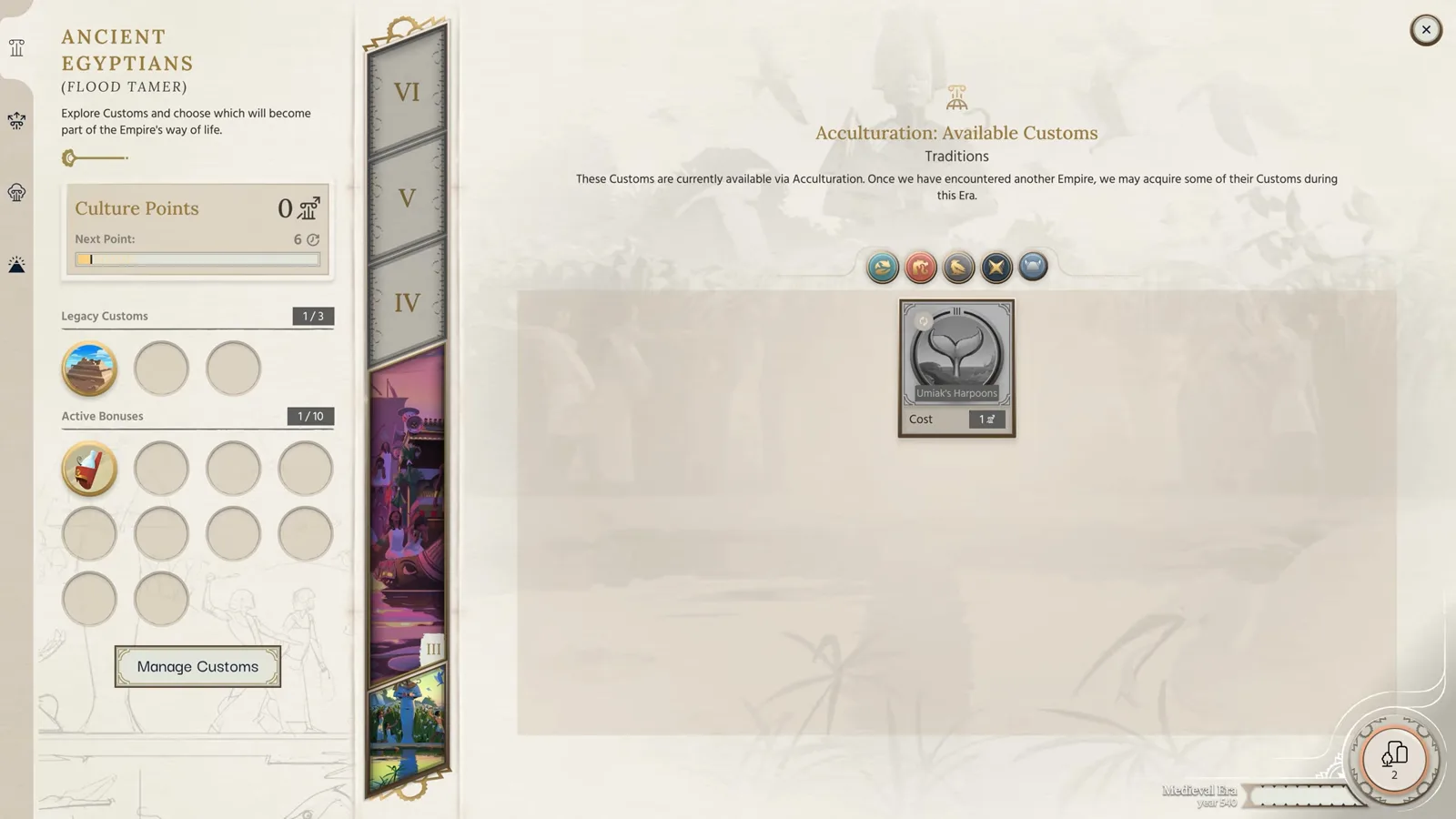
With Foreign Contact established, navigate to Manage Customs, locate Thule contributions, and purchase Dogsled Hunters using Culture Points. Confirm it appears under Available Customs, then drag it into an Active slot when your next push targets ice hexes. You remain Ancient Egyptian on the culture banner while the UI shows the borrowed Thule icon on the Custom card.
UI check: borrowed Custom icon should read Thule while your culture stays Egyptian. Watch at 5:58 ↗ - 05
Field sled-dog units for snow mobility
Recruit or upgrade into sled-dog units shown in the showcase—use them as fast recon, flanking skirmishers, and settler escorts on snow. Their value peaks when paired with Ice Crossing routes and Egyptian river logistics behind the front: Nile granaries feed the expedition while dogs hold the polar line.
Combat tip: run dogs ahead of settlers to reveal ice hazards and Thule camps. Watch at 6:08 ↗
Polar Customs vs Biome Adaptations: Comparison Table
Use this table when budgeting Culture Points versus Adaptation Points (terminology as shown in the walkthrough UI). Costs are illustrative for Pre-Release 2027; verify numbers after each patch.
| System Layer | Node / Custom | Primary Benefit | Typical Spend | Synergy With Dogsled Hunters |
|---|---|---|---|---|
| Thule Culture Custom | Dogsled Hunters | Sled-dog units, snow mobility, Arctic recon | Culture Points via Foreign Contact | Core unit package—activate before offensives |
| Polar Biome Adaptation | Ice Crossing | Safe movement on sea ice and frozen straits | Adaptation Points in Polar tree | Extends dog routes across tiles infantry cannot tread |
| Polar Biome Adaptation | Long Winter | Mitigates seasonal food and production crashes | Adaptation Points in Polar tree | Keeps cities alive while dogs scout during polar night |
| Polar Biome Adaptation | Whaling & Seal Hunting | Coastal food and trade goods on icy shores | Adaptation Points in Polar tree | Stabilizes protein while Egyptian grain ships resupply |
| Empire Management UI | Manage Customs | Active vs Available Customs slot tuning | No spend—configuration | Swap Dogsled Hunters on for war, off for bureaucracy builds |
| Economy | Culture Point income | Funds both Egyptian and foreign nodes | Fame, districts, events | Delay luxury Customs until survival nodes are online |
Strategic Analysis: Egyptians in Greenland Without Culture Swapping
Playing Ancient Egypt Flood Tamer in polar territory looks contradictory until you treat each system as a specialist layer:
- Egyptian strengths: river logistics, early administrative Customs, monument Influence, and flood-taming food spikes that finance long expeditions.
- Polar weaknesses: perishable food decay, movement penalties on snow, and seasonal production dips documented in the Biomes and Climate Adaptations guide.
- Thule borrow: Dogsled Hunters closes the mobility gap; Polar nodes close the survival gap.
Against AI, sled dogs excel at punishing slow Arctic independents and securing whaling tiles before a rival empire establishes Foreign Contact first. In multiplayer, revealing dog stacks early telegraphs Greenland intent—pair deception by keeping Dogsled Hunters in Available until the turn you declare war.
You do not need to pick Thule at the Era Crossroads unless you want their full Cultural Progression Tree and Legacy Trait package. Many players will stay Egyptian for narrative cohesion, borrowing only the Custom that fixes their map position. Browse the full roster in all 70 playable cultures to plan which neighbors you will contact in each era.
Watch the Official Segment (Inline Video)
Re-watch the Greenland sequence with the UI visible—pause at each timestamp linked in the walkthrough above.

Humankind 2 gameplay overview — Thule Dogsled Hunters and Polar biomes
Quick Checklist Before Your Next Polar Push
- Confirm Foreign Contact with Thule (not just a fleeting scout visit).
- Unlock at least one survival node in the Polar Adaptation Tree.
- Purchase Dogsled Hunters and assign an Active Customs slot.
- Escort settlers with sled-dog units across mountain passes.
- Keep Egyptian food logistics running behind the front via rivers and trade.
Culture Point pacing on a split map
Players who spawn on the Nile but scout Greenland early often feel Culture Point poor at the exact moment Foreign Contact opens. Hold one era’s worth of points in reserve when your explorer first sights ice: buy Long Winter or Ice Crossing first, Dogsled Hunters second, then backfill Egyptian administrative nodes. If you reverse that order, you can field dogs beautifully while your polar town loses population to spoilage—classic 4X trap in Humankind 2’s perishable economy.
When full Thule culture still makes sense
Choose Thule at the Era Crossroads if your capital eventually relocates north, you want their Legacy Trait capstone, and you plan to stack every Polar node natively. Borrow Dogsled Hunters instead when Egypt remains your narrative spine—monuments on the Nile, foreign customs as tactical modules—exactly as the Ancient Egypt Flood Tamer guide expedition route demonstrates.
Mastering this loop lets any culture—not only Arctic natives—treat Greenland as an extension of your empire rather than a forced culture swap. For the broader customs framework, return to Culture Evolution and Customs; for environmental counters, cross-read Biomes and Climate Adaptations.
Related Chronicles
cultures
Humankind 2 Ancient Egypt Guide: Flood Tamer & Customs
Humankind 2 Ancient Egypt (Flood Tamer): Nile traits, five Customs, desert wonders, Men-Nefer yields, and optional six-era persistence at the Crossroads.
cultures
Humankind 2 Cultures Tier List: Best Early Civilizations
Rank Humankind 2 early-era cultures for 2027 pre-release: S-tier Egyptians, Romans, Carthage, plus Persia, Thule, and steppe picks by Customs Trees.
mechanics
Humankind 2 Diplomacy, Trade & Warfare Mechanics Guide
Humankind 2 diplomacy, trade routes, and tactical border warfare: Rome vs Carthage, Persia choke points, Foreign Contact Customs, and unit command UI.
Was this chronicle helpful?
Thanks for your feedback!