
Humankind 2 Ancient Egypt Guide: Flood Tamer & Customs
Humankind 2 Ancient Egypt (Flood Tamer): Nile traits, five Customs, desert wonders, Men-Nefer yields, and optional six-era persistence at the Crossroads.
Frequently Asked Questions
How do you unlock Ancient Egypt in Humankind 2?
What do the Flood Tamer traits do in Humankind 2?
Which Customs are on the Ancient Egyptian progression tree?
Can you stay Ancient Egyptian for all six eras?
Which Egyptian cities appear in the Flood Tamer footage?
How Do You Start Ancient Egypt with the Flood Tamer First Tale?
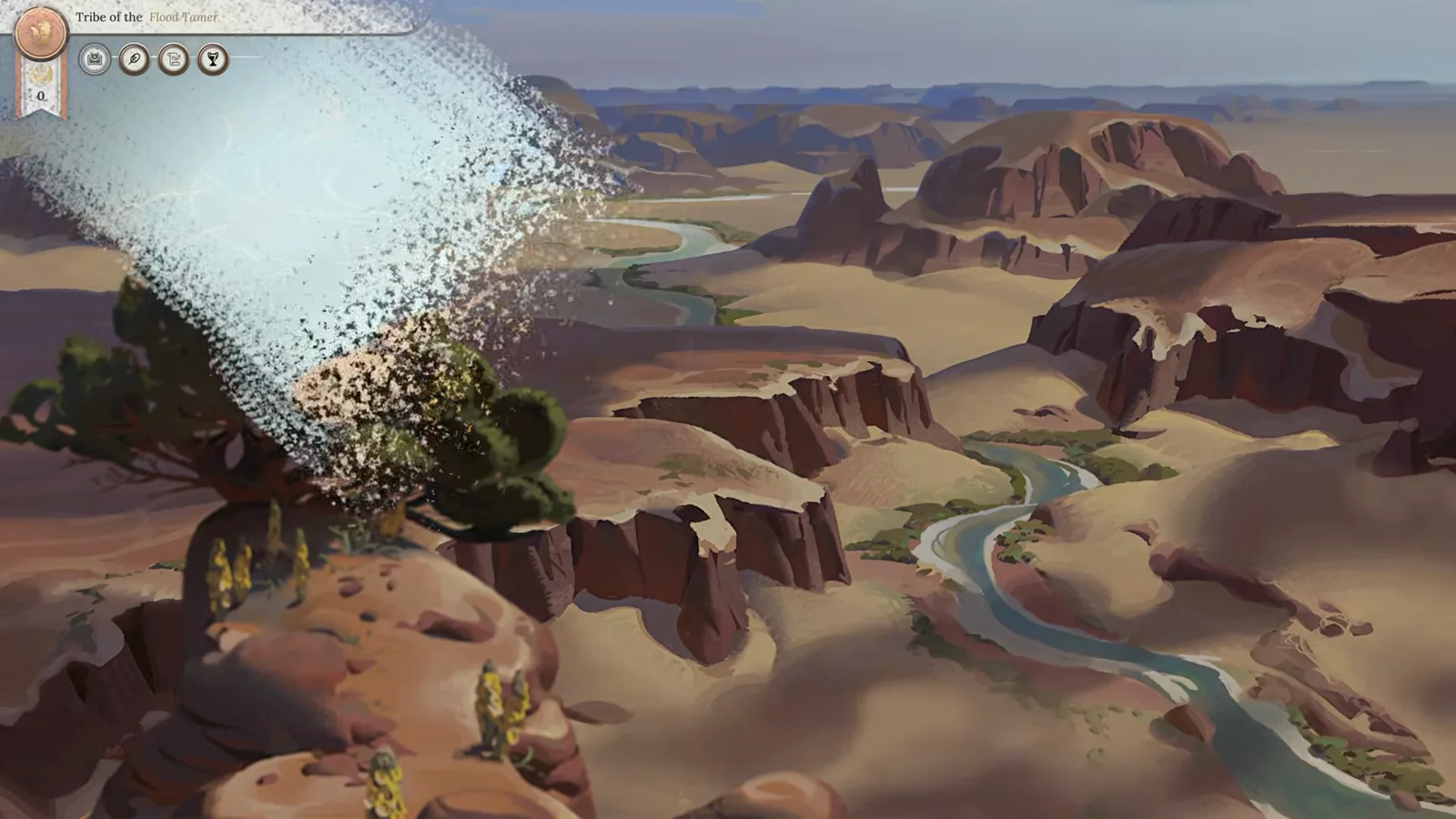
Humankind 2 uses Historical Mode to anchor your opening turns on a handcrafted Earth map built with input from more than thirty historians. When you pick the Lower Nile starting region, the campaign opens with the Flood Tamer First Tale instead of a generic Neolithic wander. The narrative frames your people as floodplain survivors learning to tame seasonal inundation, hippos, and desert margins before the pharaonic state emerges.
That choice matters mechanically, not only for flavor. Flood Tamer is the front door to Ancient Egyptians (Flood Tamer) in Era I (Ancient Era). Your empire identity begins with Diligent Traders, signaling that Nile surplus and river connectivity will feed both growth and commerce. For the full map rules and how First Tales differ from Sandbox spawns, see the Historical Mode and First Tales guide.
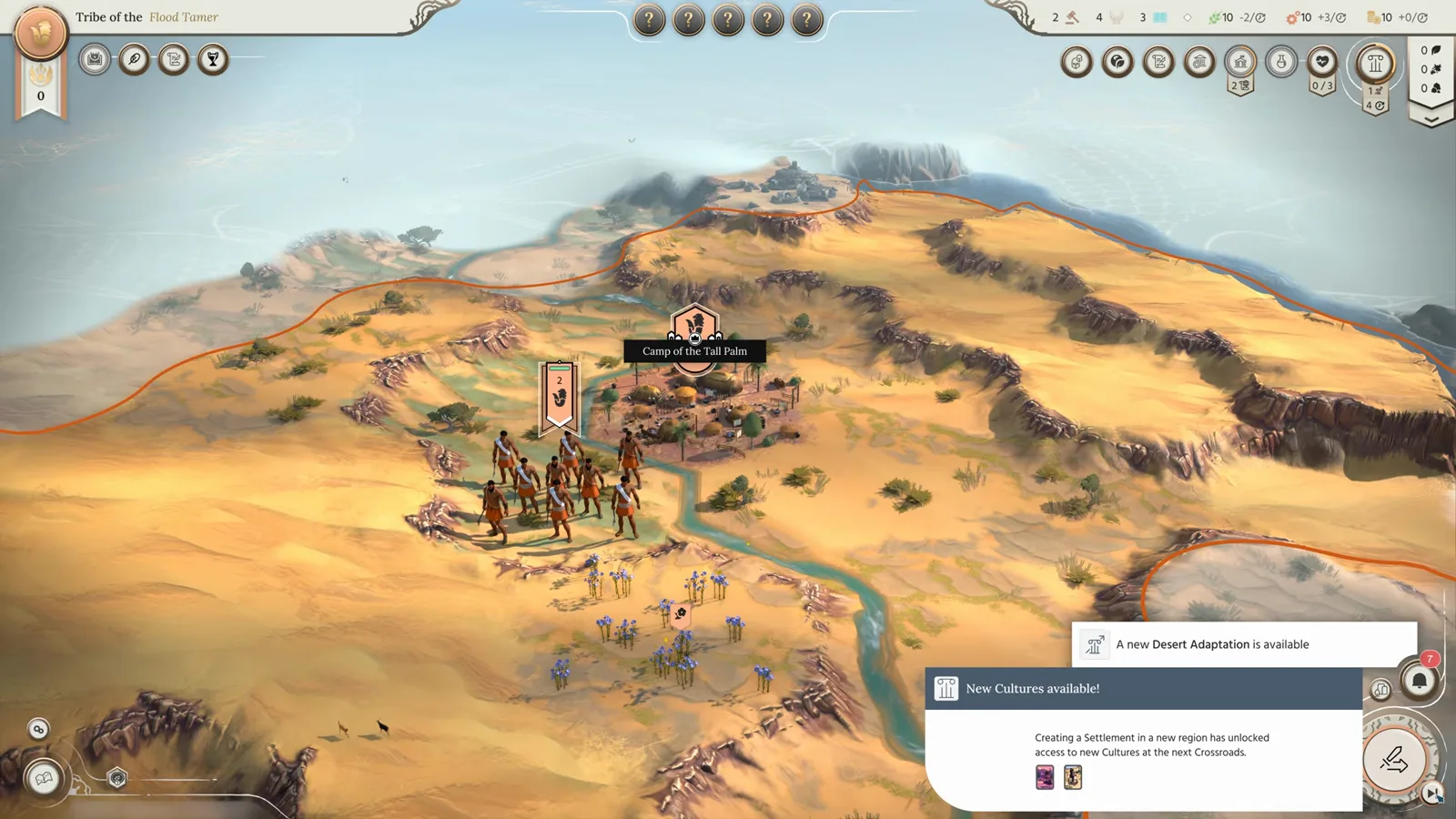
On Turn 1 footage, settlers appear along a narrow green ribbon between canyon walls and open desert. The New Citizen assignment popup highlights how early population is routed into food production before administrative districts appear. Treat the first ten turns as a race to secure river tiles, assign citizens to floodplain work, and place districts where Frontier Districts discounts matter most.
What Are the Flood Tamer Starting Traits in Humankind 2?
Selecting Flood Tamer attaches three stacked traits to your young empire. Together they describe a river civilization that expands districts cheaply and punches above its weight militarily when granaries run full.
| Trait | Effect | Practical use on the Nile |
|---|---|---|
| Abundant Waters | +2 Food from River or Water tiles | Prioritize settling and improving hexes adjacent to the Nile and irrigation channels; food spikes enable faster citizen growth in capital and satellite towns. |
| Frontier Districts | -25% Industry cost for new districts | Rush administrative and production districts early while population is still low; the discount compounds when you found Men-Nefer-style secondary cities. |
| Source of Strength | +5 Strength to units in settlements with a positive food surplus | Garrison defenders in food-positive cities during hippo raids or neighbor probes; offensive stacks benefit when you forward-base out of surplus towns like Men-Nefer. |
These bonuses sit on top of the culture identity trait Diligent Traders, which reinforces trade-oriented play along navigable rivers. None of the Flood Tamer traits replace the Customs system—they accelerate your opening economy while you earn Culture Points for the progression tree described below.
If you are comparing Era I openings across civilizations, the early era cultures tier list ranks how river food, district timing, and military tempo interact on Historical starts.
How Does the Ancient Egyptian Customs Progression Tree Work?
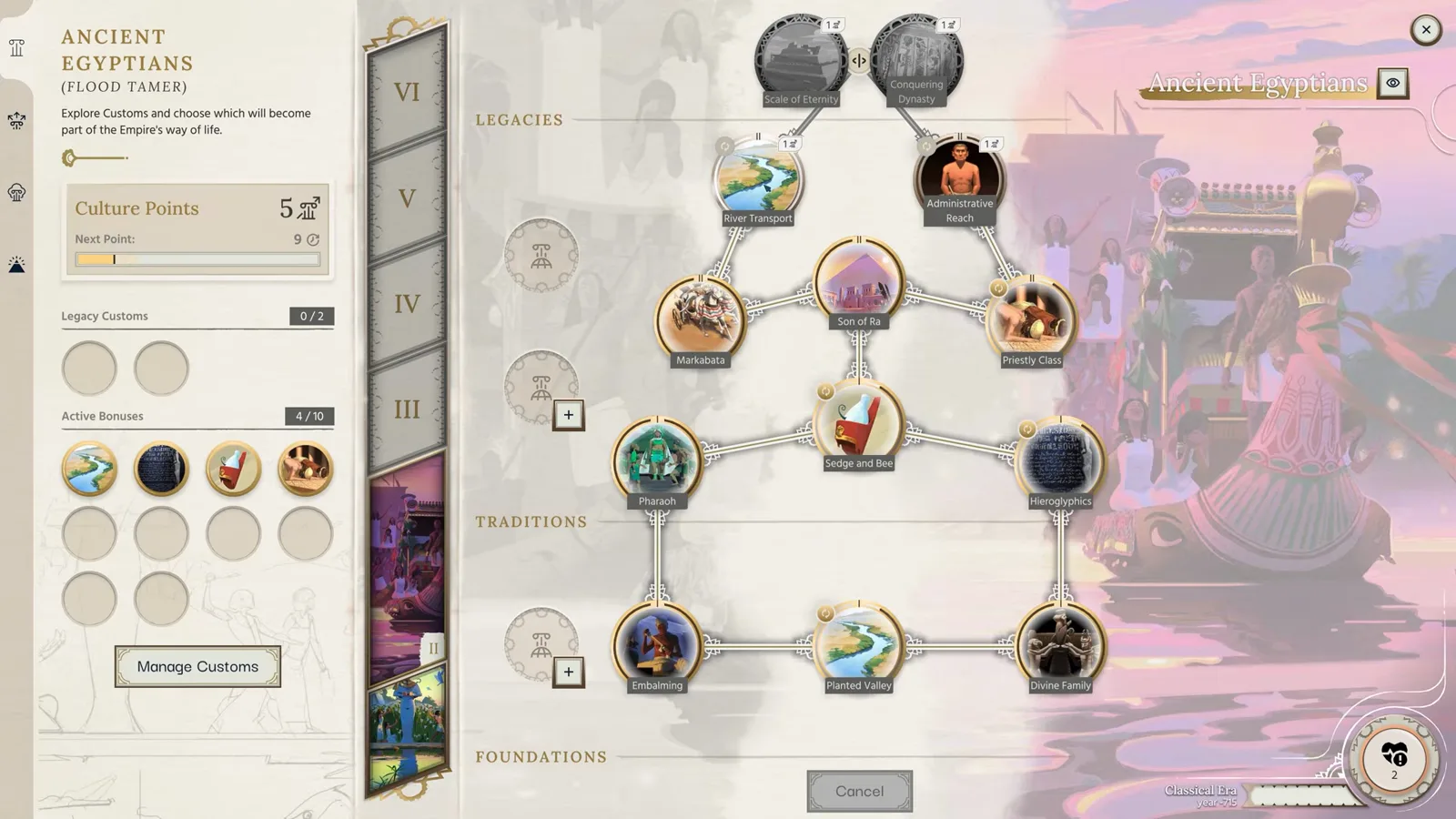
Every culture in Humankind 2 owns a multi-node Cultural Progression Tree unlocked through Manage Customs. Ancient Egypt’s tree is the clearest example in official footage: five nodes arranged vertically from Era I forward, culminating in a permanent Legacy Trait once you complete the chain.
Tier 1 Customs: River Transport and Hieroglyphics
River Transport is the logistics backbone. It speeds movement and trade along river hexes—critical when your empire stretches from Upper Egypt settlements to Delta ports. Unlock it as soon as Culture Points allow so scouts and merchants exploit the Nile backbone instead of crawling through desert choke points.
Hieroglyphics shifts your administrative ceiling. Monumental writing boosts science, influence, and state capacity, pairing naturally with temple districts you will later empower through Priestly Class. For the global rules on Culture Points, Crossroads persistence, and borrowing foreign Customs, read the culture evolution and Customs guide.
Tier 2–3: Priestly Class and Governance Capstones
Priestly Class strengthens religious districts and stabilizes multi-city empires when food surpluses swing seasonally. The two advanced nodes—Pharaoh’s Authority and Viziers in walkthrough UI—centralize imperial edicts and multi-city governance. Completing all five nodes and confirming selections in Manage Customs awards Egypt’s Legacy Trait, a permanent capstone distinct from the temporary Flood Tamer trait bundle.

Humankind 2 Gameplay Overview — Ancient Egypt Flood Tamer and Customs
Do not rush the final node if your economy cannot support temple maintenance and district upkeep. A common mistake is spending Culture Points purely for flavor while Frontier Districts-discounted industry districts remain unbuilt—balance tree progression with physical city planning on irrigated tiles.
Which Cities and Wonders Show Up in Flood Tamer Footage?
The October 2026 walkthrough treats Egypt as a long-form sandbox within Historical Mode, revealing mid-game settlements and wonder projects that define your strategic targets.
Men-Nefer, Nekhen, and Giza
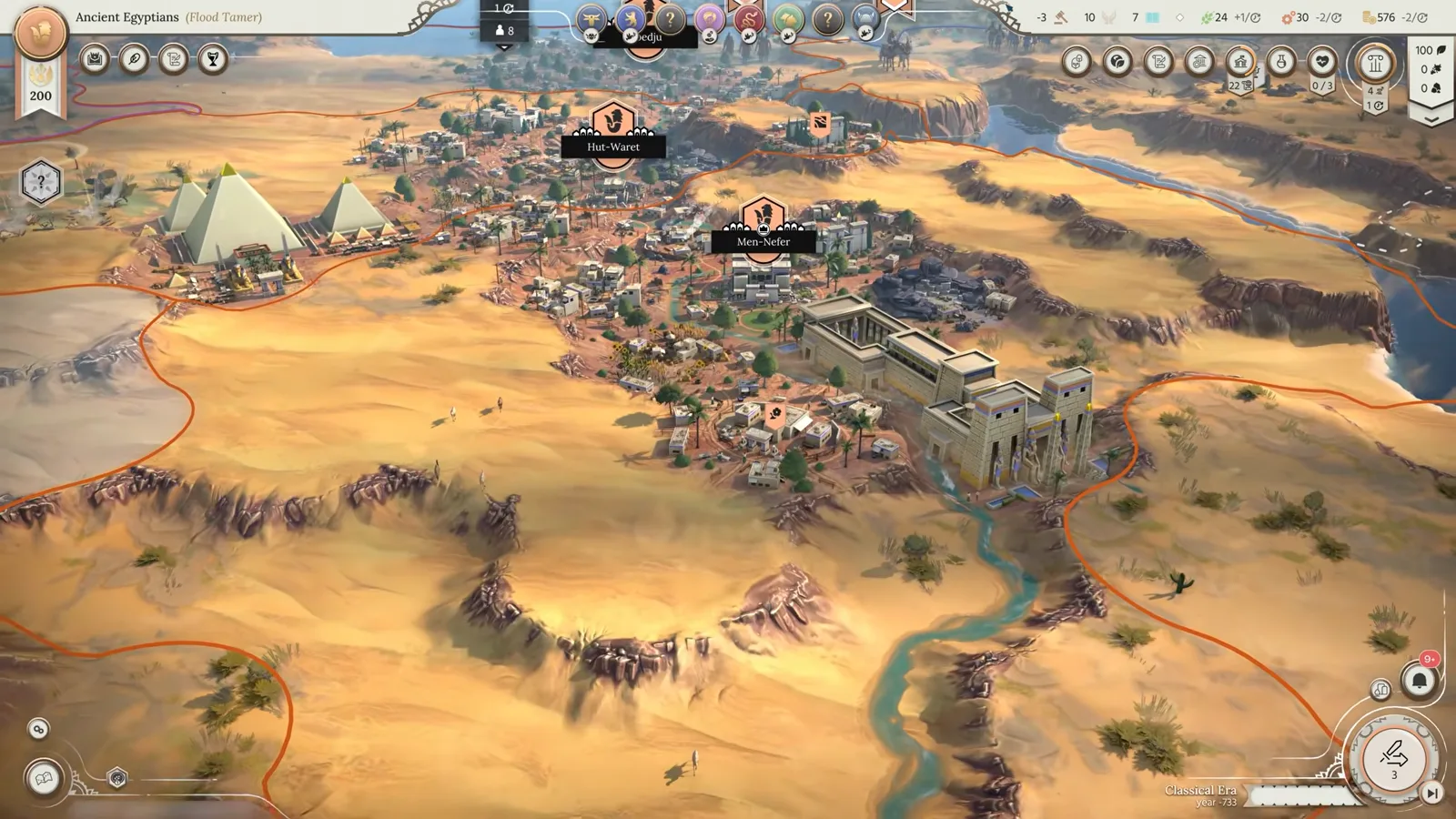
Men-Nefer appears as a mature city at 16/10 population, generating +40 Food and +6 Gold in the same UI frame—evidence that Nile food stacking and trade yields scale together when districts and river tiles align. Use Men-Nefer as your benchmark for Source of Strength garrisons: keep the city food-positive before wars of expansion.
Nekhen showcases a stone temple complex layout, ideal for testing Priestly Class yields once unlocked. Giza demonstrates coastal and river forest expansion toward desert wonders, blending green hexes with arid backdrop tiles.
Wonders and desert synergy
Confirmed wonder construction includes the Temple of Ra hugging the Nile, the Great Pyramids dominating the Giza skyline, and later-era Lighthouse of Alexandria as a maritime capstone on Egypt’s Mediterranean face. These projects interact with Desert Adaptations from the biomes and climate adaptations guide: Wells, camel caravans, and perishable food storage let you push industry and armies into dunes without starving distant cities.
Can You Keep Ancient Egypt Across All Six Eras?
Yes—and footage explicitly shows Ancient Egyptians listed on an Era I–VI vertical track, meaning persistence is a supported strategy rather than a meme build. At each Era Crossroads you may remain your current culture instead of evolving into Carthaginians, Abbasids, Byzantines, or other linked successors.
Staying Egyptian trades the spike bonuses of a fresh Classical or Medieval culture for deep mastery: more Customs tiers filled, wonders completed, and foreign tricks adopted through Foreign Contact. The walkthrough’s alternate history beat—Egyptian settlers pushing north into Greenland and unlocking Dogsled Hunters from the Thule—proves you can hybridize without abandoning identity. Step-by-step adoption rules live in the Thule Dogsled Hunters Custom guide.
What Is the Optimal Flood Tamer Opening Checklist?
Use this turn-order checklist after selecting Flood Tamer on Historical Mode:
- Claim river and water hexes first to maximize Abundant Waters before desert expansion.
- Spend Frontier Districts discounts on the first two administrative or industrial districts in your capital.
- Assign New Citizens to food until the capital shows a stable surplus, then garrison for Source of Strength.
- Unlock River Transport, then Hieroglyphics, before founding Men-Nefer-scale secondary cities.
- Invest in Desert Adaptations (Wells and caravans) before long desert wars or wonder builds away from the Nile.
- Plan Crossroads early: decide whether Era II persistence or Carthaginian evolution fits your map control.
Following that sequence mirrors the official showcase: fertile Nile core, discounted district spam, military strength tied to granaries, temple-powered mid-game, and optional polar detours through Thule Customs—without ever leaving the Ancient Egyptians (Flood Tamer) banner if you choose not to.
Related Chronicles
cultures
Humankind 2 Cultures Tier List: Best Early Civilizations
Rank Humankind 2 early-era cultures for 2027 pre-release: S-tier Egyptians, Romans, Carthage, plus Persia, Thule, and steppe picks by Customs Trees.
guides
Humankind 2 Earth Starting Locations & First Tales Guide
Earth starting locations in Humankind 2 Historical Mode: 20 First Tale pins, Wild Twins and Flood Tamer traits, Nile Turn 1 spawns, cradle comparison table.
mechanics
Humankind 2 Sled Dogs Guide: Thule Customs & Polar Units
Adopt Thule Dogsled Hunters in Humankind 2 via Foreign Contact, unlock Polar Adaptations, and deploy sled-dog scouts without abandoning Egyptian culture.
Was this chronicle helpful?
Thanks for your feedback!